Best Books for Critical Thinking: Top 20 Books to Sharpen Your Mind
Critical thinking is one of the most valuable skills you can develop. Every day, we make decisions at school, work, and in our personal lives. The ability to analyze information, identify facts, question assumptions, and make informed decisions helps you avoid mistakes and solve problems more effectively.
Reading the best books for critical thinking is one of the easiest ways to strengthen these skills. Well-written books expose you to different perspectives, logical reasoning, psychology, decision-making techniques, and problem-solving strategies that you can apply in everyday life.
Whether you’re a student preparing for exams, a professional making important business decisions, or simply someone who wants to think more clearly, the books in this guide can help you become a better thinker.
In this article on Emaratsmart.com, you’ll discover the best books for critical thinking, learn how to choose the right one, and find practical tips to apply what you read.
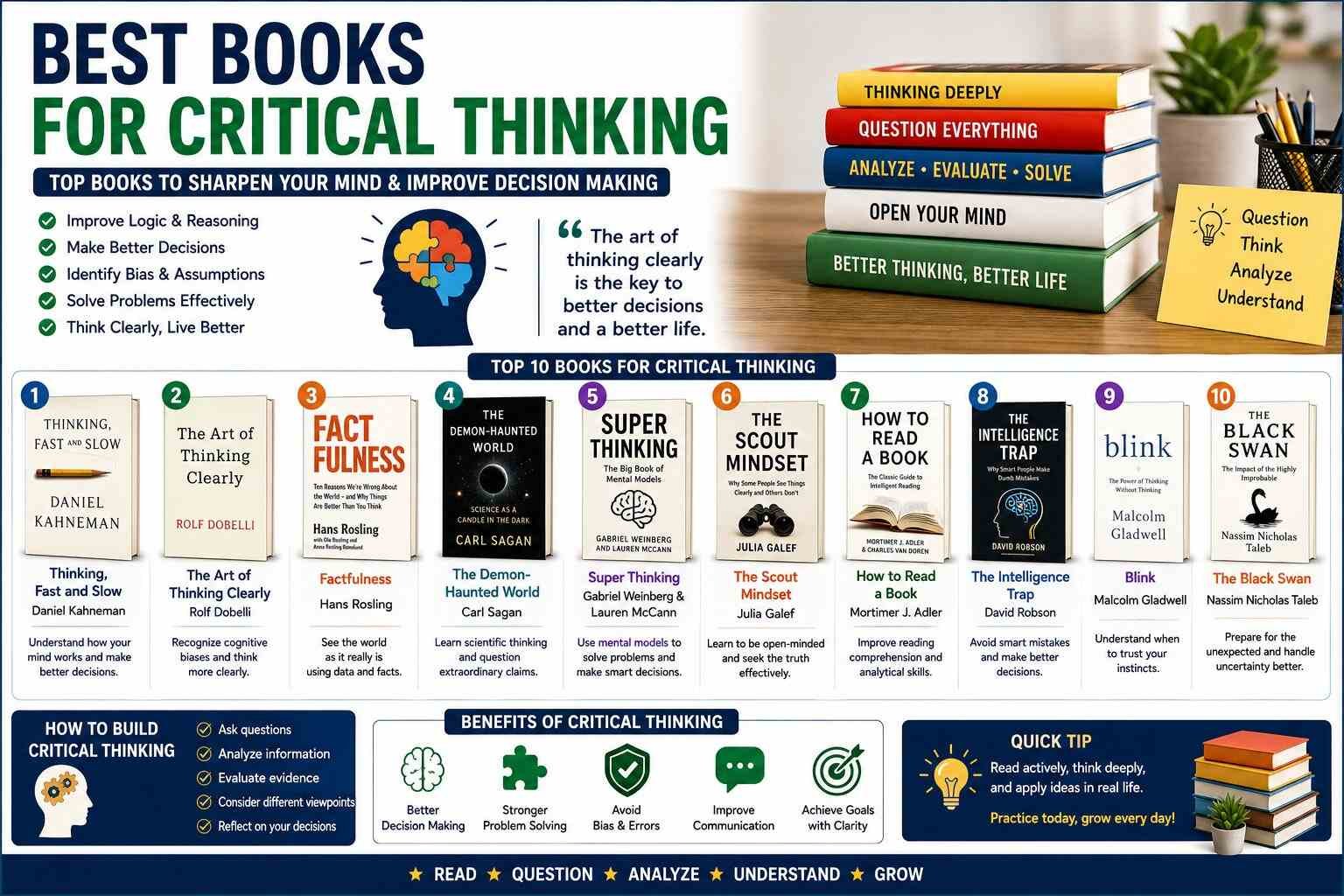
Quick Comparison of the Best Critical Thinking Books
| Book | Author | Best For | Difficulty |
|---|---|---|---|
| Thinking, Fast and Slow | Daniel Kahneman | Decision Making | Intermediate |
| The Demon-Haunted World | Carl Sagan | Scientific Thinking | Beginner |
| Super Thinking | Gabriel Weinberg & Lauren McCann | Mental Models | Beginner |
| The Art of Thinking Clearly | Rolf Dobelli | Everyday Decisions | Beginner |
| Factfulness | Hans Rosling | Data & Statistics | Beginner |
| The Intelligence Trap | David Robson | Smarter Decisions | Intermediate |
| How to Read a Book | Mortimer J. Adler | Better Learning | Beginner |
| The Scout Mindset | Julia Galef | Open-Minded Thinking | Beginner |
Quick Tip: Don’t just read these books—apply one idea from each chapter to a real-life decision. Practicing critical thinking is what turns knowledge into skill.
What Is Critical Thinking?
Critical thinking is the ability to evaluate information objectively before forming an opinion or making a decision. It involves asking thoughtful questions, examining evidence, recognizing bias, and considering multiple viewpoints instead of accepting information at face value.
Strong critical thinkers often:
- Ask “Why?” before accepting a claim.
- Verify facts using reliable sources.
- Compare different opinions.
- Look for evidence rather than assumptions.
- Recognize emotional bias.
- Solve problems logically.
- Make informed decisions.
These skills are valuable in education, business, technology, and everyday life.
Why Reading Improves Critical Thinking
Reading quality books exposes you to new ideas and teaches you how experienced authors analyze complex topics.
Regular reading helps you:
- Improve logical reasoning
- Expand vocabulary
- Strengthen analytical skills
- Improve decision-making
- Understand different perspectives
- Identify misinformation
- Develop independent thinking
- Become a better communicator
The more diverse your reading, the stronger your ability to evaluate ideas critically.
1. Thinking, Fast and Slow – Daniel Kahneman
This bestselling book explains how the human brain makes decisions using two different thinking systems—fast, intuitive thinking and slow, analytical thinking.
Why Read It?
- Understand cognitive biases
- Make better decisions
- Improve judgment
- Learn how emotions affect thinking
Best for: Professionals, students, and anyone interested in psychology and decision-making.
2. The Art of Thinking Clearly – Rolf Dobelli
This book explores common thinking errors that influence our decisions. Each chapter explains a different cognitive bias in a simple and practical way.
You’ll Learn:
- Confirmation bias
- Survivorship bias
- Overconfidence
- Social proof
- Decision traps
It’s an excellent choice for beginners because each chapter is short and easy to understand.
3. Factfulness – Hans Rosling
Factfulness teaches readers how to interpret statistics accurately and avoid common misconceptions about the world.
The authors explain why many people hold inaccurate beliefs and how data can help us make better decisions.
Key lessons include:
- Understanding global trends
- Evaluating statistics correctly
- Avoiding emotional assumptions
- Recognizing misleading information
4. The Demon-Haunted World – Carl Sagan
Carl Sagan encourages readers to question extraordinary claims and rely on evidence rather than superstition or misinformation.
This book introduces scientific thinking in an engaging and accessible way, making it ideal for anyone who wants to develop a more evidence-based approach to reasoning.
5. Super Thinking – Gabriel Weinberg & Lauren McCann
This practical guide introduces mental models—frameworks that help you analyze situations more effectively and make smarter decisions.
You’ll discover concepts such as:
- Opportunity cost
- Second-order thinking
- Feedback loops
- Incentives
- Pareto Principle
- Decision trees
These models can be applied to business, education, and everyday life.
6. The Scout Mindset – Julia Galef
Many people defend their opinions instead of searching for the truth. The Scout Mindset teaches you how to stay curious, question your beliefs, and evaluate evidence fairly.
Why It’s Worth Reading
- Improve open-minded thinking
- Reduce personal bias
- Make smarter decisions
- Evaluate evidence objectively
Best for: Students, leaders, professionals, and lifelong learners.
7. How to Read a Book – Mortimer J. Adler & Charles Van Doren
Reading isn’t just about finishing pages—it’s about understanding and analyzing ideas. This classic book teaches readers how to read actively and think critically about what they read.
Key Lessons
- Read with purpose
- Ask questions while reading
- Analyze arguments
- Compare different viewpoints
- Remember information more effectively
8. The Intelligence Trap – David Robson
Being intelligent doesn’t always mean making good decisions. This book explains why smart people sometimes make poor choices and how to avoid common thinking mistakes.
You’ll Learn
- How bias affects intelligence
- Better decision-making strategies
- Critical evaluation techniques
- Practical reasoning skills
9. The Black Swan – Nassim Nicholas Taleb
Unexpected events can change everything. This book explores how rare, unpredictable events influence business, finance, and everyday life.
Why Read It?
- Understand uncertainty
- Think beyond assumptions
- Improve risk assessment
- Learn long-term decision-making
10. Blink – Malcolm Gladwell
Blink explores how people make quick decisions and when trusting your instincts can be useful—or misleading.
Readers learn the importance of balancing intuition with careful analysis.
How to Choose the Right Critical Thinking Book
Different books focus on different aspects of thinking. Choose one that matches your goals.
| Goal | Recommended Book |
|---|---|
| Better Decision Making | Thinking, Fast and Slow |
| Everyday Thinking | The Art of Thinking Clearly |
| Scientific Reasoning | The Demon-Haunted World |
| Understanding Data | Factfulness |
| Mental Models | Super Thinking |
| Reading Skills | How to Read a Book |
| Open-Minded Thinking | The Scout Mindset |
| Understanding Bias | The Intelligence Trap |
Practical Ways to Build Critical Thinking
Reading is only the first step. To improve faster, apply what you learn every day.
Try these habits:
- Ask “What evidence supports this?”
- Read from multiple reliable sources.
- Challenge your own assumptions.
- Keep a journal of important decisions.
- Discuss ideas with people who have different viewpoints.
- Solve logic puzzles and brain teasers.
- Reflect on mistakes and what you learned from them.
Common Mistakes That Limit Critical Thinking
Many people unknowingly develop habits that weaken their reasoning.
Avoid these common mistakes:
- Believing information without checking the source.
- Relying only on social media headlines.
- Ignoring opinions that differ from your own.
- Letting emotions replace evidence.
- Making quick decisions without enough information.
- Assuming experts are always correct without understanding their reasoning.
Recognizing these habits is an important step toward becoming a stronger critical thinker.
Benefits of Reading Critical Thinking Books
Consistently reading and applying these ideas can help you:
- Make better personal and professional decisions.
- Improve problem-solving skills.
- Recognize misinformation.
- Communicate more clearly.
- Build confidence in discussions.
- Strengthen analytical thinking.
- Improve academic performance.
- Become a more informed reader and learner.
Safety Note
Critical thinking is about evaluating ideas—not rejecting them automatically. When researching important topics such as health, finance, or legal matters, always rely on trustworthy sources and qualified professionals. Use the skills you develop through these books to ask informed questions and assess evidence carefully.
Official Resources
To continue improving your critical thinking skills, explore these trusted resources:
- The Foundation for Critical Thinking: https://www.criticalthinking.org/
- Project Gutenberg (Free Classic Books): https://www.gutenberg.org/
- Open Library: https://openlibrary.org/
Recommended External Link: If you’re adding only one outbound link for SEO, use https://www.criticalthinking.org/ because it is dedicated to critical thinking education and provides valuable learning resources.
Frequently Asked Questions
What is the best book for critical thinking?
There isn’t a single best book for everyone, but these are among the most recommended:
- Thinking, Fast and Slow by Daniel Kahneman
- The Art of Thinking Clearly by Rolf Dobelli
- Factfulness by Hans Rosling
- The Demon-Haunted World by Carl Sagan
- Super Thinking by Gabriel Weinberg & Lauren McCann
Each book focuses on a different aspect of critical thinking, such as decision-making, logic, scientific reasoning, or mental models.
Which critical thinking book is best for beginners?
For beginners, The Art of Thinking Clearly, Factfulness, and Super Thinking are excellent choices because they explain complex ideas using simple language and practical examples.
Can reading improve critical thinking?
Yes. Reading exposes you to new ideas, different viewpoints, and logical arguments. It also helps you evaluate evidence, identify bias, and make better decisions.
How long does it take to improve critical thinking?
There is no fixed timeline. Reading regularly, questioning assumptions, and applying what you learn in daily life can lead to noticeable improvement within a few months.
Are critical thinking books useful for students?
Absolutely. They help students analyze information, write stronger essays, solve problems, prepare for exams, and make informed decisions in both academic and personal settings.
Which book is best for decision-making?
Thinking, Fast and Slow by Daniel Kahneman is widely regarded as one of the best books for understanding decision-making, cognitive biases, and human judgment.
Should I read more than one critical thinking book?
Yes. Each author offers a different perspective. Reading multiple books gives you a broader understanding of logic, psychology, reasoning, and problem-solving techniques.
Can critical thinking help in everyday life?
Definitely. Strong critical thinking skills can help you:
- Make better financial decisions.
- Evaluate news and online information.
- Solve problems more effectively.
- Improve communication.
- Reduce common thinking errors.
- Make more confident choices.
Conclusion
Choosing the best books for critical thinking is an investment in your personal and professional growth. These books don’t just teach theories—they provide practical tools to help you analyze information, question assumptions, recognize bias, and solve problems more effectively.
Whether you’re a student, educator, business professional, or lifelong learner, developing critical thinking skills can improve the way you learn, communicate, and make decisions. Start with one book that matches your interests, apply its lessons in everyday situations, and gradually explore other titles to broaden your perspective.
Remember, critical thinking is a skill that grows with consistent practice. Read actively, ask thoughtful questions, evaluate evidence carefully, and stay open to new ideas.
For more expert book recommendations, learning resources, education guides, and self-improvement articles, keep visiting EmaratSmart.com.