Kids Science Experiments at Home: Easy UAE Guide
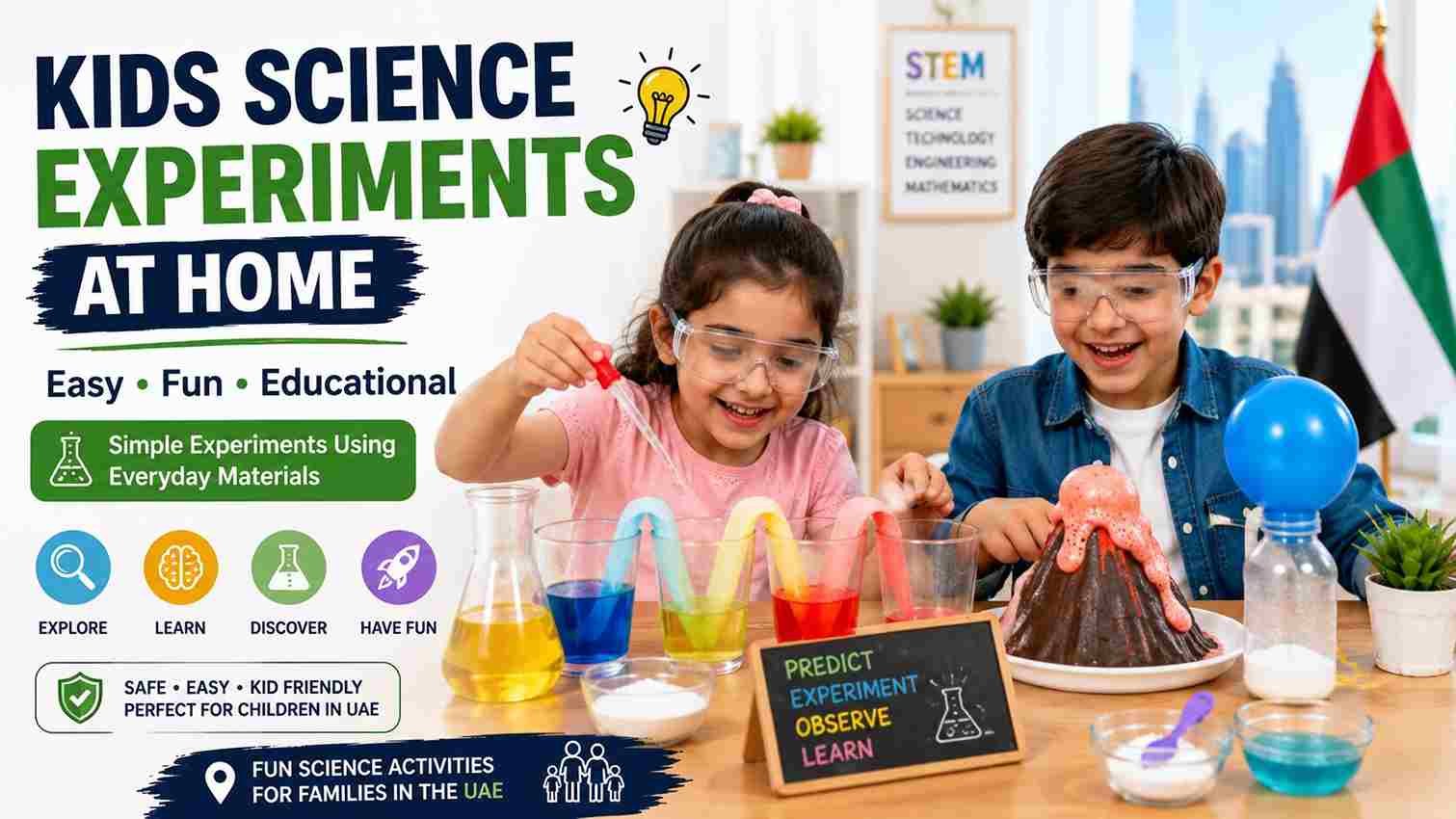
Looking for kids science experiments at home? You don’t need expensive equipment or a science lab to help children learn.
Many fun experiments can be done with simple things you already have at home. These activities can help children understand science while having fun.
For families in the UAE, home science activities are a great option for weekends, school holidays, or hot days when children spend more time indoors.
Always choose activities that are suitable for your child’s age and have an adult nearby when needed.
Official UAE Education Resource:
The UAE Ministry of Education’s Kindergarten Parent Guide encourages children to learn science through inquiry, observation, predictions, and hands-on activities using everyday materials. Parents can use it for ideas on supporting science learning at home.
Official Link: UAE Ministry of Education – Kindergarten Parent Guide
Why Kids Science Experiments at Home?
Science experiments help children learn by doing.
They can improve:
- Observation skills
- Creativity
- Problem-solving
- Critical thinking
- Curiosity
Children can make a guess, try an experiment, and see what happens.
1. Sink or Float Experiment
This is one of the easiest science experiments for kids at home.
You Need
- A bowl
- Water
- A few safe household objects
Put water in the bowl.
Ask your child which objects they think will sink and which will float.
Test each object and see if their predictions were correct.
What kids learn: They learn about different materials and how objects behave in water.
2. Ice Melting Experiment
This is a simple activity that is especially interesting during hot weather in the UAE.
You Need
- Ice cubes
- Two plates
Put one ice cube in a cooler place and another in a warmer place.
Watch them for a while.
Which ice cube melts faster?
What kids learn: They can see how temperature affects melting.
3. Balloon Static Electricity
This experiment is fun and easy.
You Need
- A balloon
- Small pieces of paper
Rub the balloon on dry hair or suitable fabric.
Bring the balloon close to the paper pieces.
The paper may move toward the balloon.
What kids learn: This introduces children to the basic idea of static electricity.
4. Sink or Float Plant Experiment
You can also use fruits and vegetables for a simple floating experiment.
You Need
- A bowl of water
- Different fruits or vegetables
Ask your child to predict which items will float.
Test them one by one.
What kids learn: Children practice making predictions and observing results.
5. Plant Growing Experiment
Growing a plant is a great way for children to learn about nature.
You Need
- Seeds
- Soil
- Small pots
- Water
Plant the seeds and place them where they can receive suitable light.
Ask your child to check the plant every day.
What kids learn: They learn that plants need the right conditions to grow.
6. Magnet Experiment
If you have a magnet at home, try this simple activity.
You Need
- A magnet
- Different safe objects
Ask your child which objects they think the magnet will attract.
Test each object.
What kids learn: Children discover that magnets attract some materials but not others.
Keep magnets away from young children and electronic devices that may be affected by magnets.
7. Paper Bridge Challenge
This is a fun activity for children who like building things.
You Need
- Paper
- Two books
- Small safe objects
Place two books a short distance apart.
Use paper to make a bridge between them.
Then see how many small objects the bridge can hold.
Try folding the paper in different ways and test again.
What kids learn: This introduces simple engineering and problem-solving.
8. Walking Water Experiment
This colorful experiment is easy to set up.
You Need
- Clear cups
- Water
- Paper towels
- Food coloring, if available
Put colored water in one or two cups.
Place paper towels between the cups.
Watch what happens over time.
What kids learn: Children can observe how water moves through an absorbent material.
Science Activities for Kids in the UAE
Parents in the UAE can use simple home experiments during weekends and school holidays.
During very hot weather, children may spend more time indoors. A short science activity can turn some of that time into learning.
Parents can ask simple questions:
- What do you think will happen?
- Why did this happen?
- Was your prediction correct?
- What would happen if we changed something?
These questions help children think like young scientists.
STEM Activities for Kids
STEM means:
- Science
- Technology
- Engineering
- Mathematics
Many home experiments are simple STEM activities.
For example, children can build a paper bridge, grow a plant, or test which objects float.
These activities help children practice thinking, testing, and solving problems.
Simple Safety Tips
Safety should always come first.
Parents should:
- Choose age-appropriate activities.
- Supervise young children.
- Never let children taste experiment materials.
- Keep small objects away from young children.
- Avoid dangerous chemicals.
- Avoid fire and high heat.
- Wash hands after activities.
If you are unsure whether an experiment is safe, don’t try it.
How to Make Science More Fun
You don’t need to make every experiment complicated.
Let children:
- Make a prediction.
- Do the experiment.
- Watch what happens.
- Talk about the result.
You can also give children a small notebook to record their experiments.
They can write or draw:
- What they used
- What they expected
- What happened
- What they learned
What If the Experiment Doesn’t Work?
That’s okay!
Science does not always give the result we expect.
Ask your child:
“Why do you think this happened?”
Then try to understand what went wrong.
This teaches children that mistakes can help us learn.
Frequently Asked Questions
What are easy science experiments for kids at home?
Simple activities such as sink-or-float tests, ice melting, magnets, plant growing, and paper bridge challenges are good options.
Can children do science experiments at home in the UAE?
Yes. Many simple activities can be done at home using everyday materials.
Do science experiments need expensive equipment?
No. Many beginner experiments use basic items such as water, paper, balloons, and household objects.
Are home science experiments safe?
Simple activities can be safe when they are age-appropriate and properly supervised. Avoid dangerous chemicals, fire, and other unsafe materials.
What can kids learn from home experiments?
Children can improve observation, creativity, curiosity, critical thinking, and problem-solving skills.
Conclusion
Kids science experiments at home are a simple way to make learning fun.
You don’t need a science lab or expensive equipment. With basic materials and a little creativity, children can explore science through simple activities.
For families in the UAE, these experiments are especially useful during weekends, school holidays, or hot days when children stay indoors.
Start with one easy experiment and let your child ask questions, make predictions, and discover the results.
For more simple education guides, learning activities, and useful UAE information, keep visiting EmaratSmart.com.