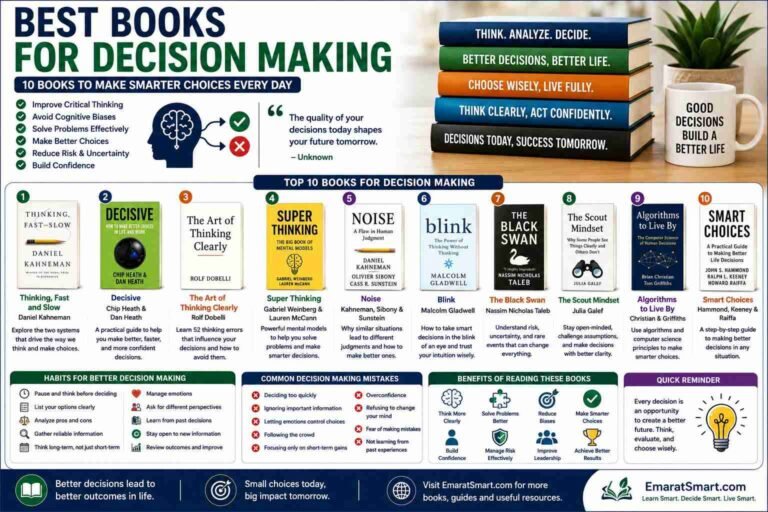
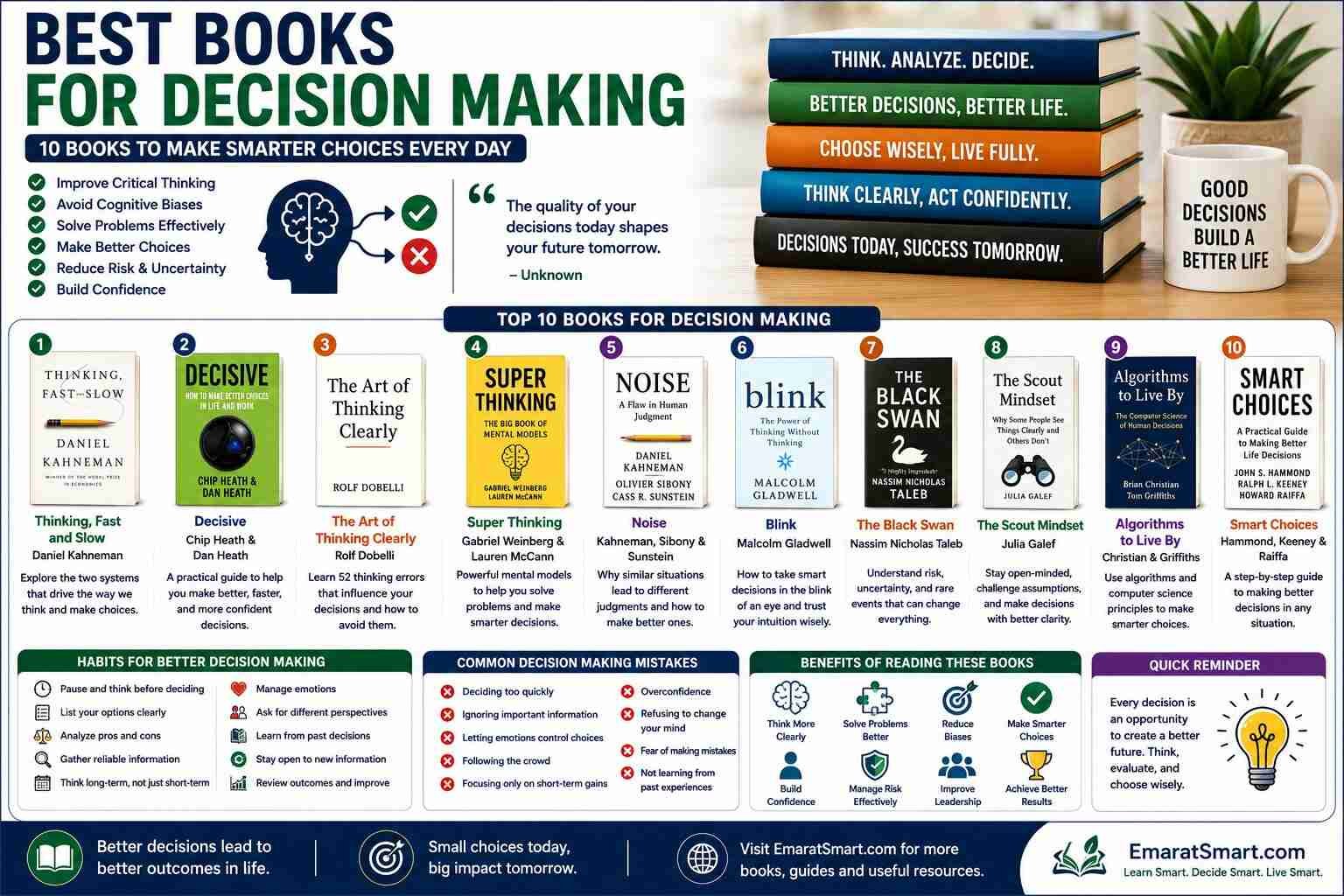
Best Books for Decision Making: 10 Books to Make Smarter Choices Every Day
Every day, we make hundreds of decisions—some small, like choosing what to eat, and others life-changing, such as selecting a career, investing money, or starting a business. While some decisions come naturally, many require careful thinking, analysis, and confidence.
The good news is that decision making is a skill you can improve. By learning from experts in psychology, business, behavioral economics, and leadership, you can make better choices, avoid common mistakes, and approach problems with greater clarity.
The best books for decision making explain why people make poor decisions, how emotions and biases influence judgment, and what practical strategies you can use to think more clearly. Whether you’re a student, entrepreneur, manager, or lifelong learner, these books will help you become a more confident and effective decision-maker.
Quick Comparison of the Best Decision-Making Books
| Book | Best For | Difficulty |
|---|---|---|
| Thinking, Fast and Slow | Understanding Decisions | Intermediate |
| Decisive | Everyday Decision Making | Beginner |
| The Art of Thinking Clearly | Avoiding Biases | Beginner |
| Super Thinking | Mental Models | Beginner |
| Noise | Better Judgment | Intermediate |
| Blink | Intuitive Decisions | Beginner |
| The Black Swan | Risk & Uncertainty | Intermediate |
| The Scout Mindset | Open-Minded Thinking | Beginner |
| Algorithms to Live By | Smarter Choices | Intermediate |
| Smart Choices | Practical Decision Frameworks | Beginner |
Quick Tip: Before making an important decision, write down at least three possible options and list the pros and cons of each. This simple habit can help reduce emotional bias and lead to better outcomes.
Why Decision-Making Skills Matter
Strong decision-making skills can improve almost every area of life.
They help you:
- Solve problems effectively
- Manage money wisely
- Choose better career opportunities
- Improve leadership skills
- Reduce costly mistakes
- Build confidence
- Think critically
- Make informed long-term decisions
Learning how to evaluate information objectively is one of the most valuable life skills you can develop.
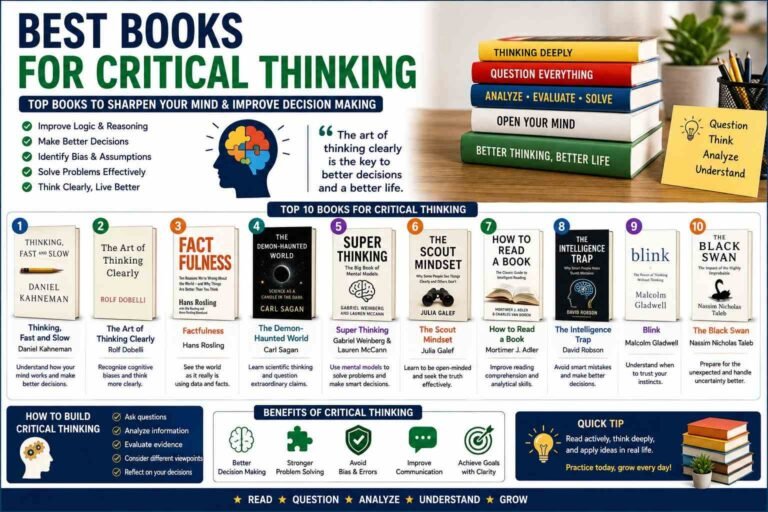
1. Thinking, Fast and Slow – Daniel Kahneman
Written by Nobel Prize-winning psychologist Daniel Kahneman, this classic explains how our minds use two different thinking systems: fast, intuitive thinking and slow, analytical thinking.
You’ll Learn
- Cognitive biases
- Better judgment
- Decision-making psychology
- Logical reasoning
- Risk assessment
Best for: Readers who want to understand why people make irrational decisions.
2. Decisive – Chip Heath & Dan Heath
This practical guide introduces a simple framework for making better decisions in both personal and professional life.
Why Read It?
- Avoid common decision traps
- Evaluate more options
- Reduce emotional bias
- Improve confidence
Its practical examples make it one of the easiest books to apply immediately.
3. The Art of Thinking Clearly – Rolf Dobelli
This bestselling book explains dozens of common thinking errors that influence everyday decisions.
Topics include:
- Confirmation bias
- Overconfidence
- Social proof
- Survivorship bias
- Loss aversion
Each chapter is short, practical, and easy to understand.
4. Super Thinking – Gabriel Weinberg & Lauren McCann
This book introduces mental models—powerful thinking frameworks that help you analyze situations and make better decisions.
You’ll discover concepts such as:
- Opportunity cost
- Incentives
- Feedback loops
- Second-order thinking
- Pareto Principle
These mental models can be applied to business, education, finance, and everyday life.
5. Noise – Daniel Kahneman, Olivier Sibony & Cass R. Sunstein
While bias causes predictable mistakes, noise refers to inconsistent judgment. This book explains why similar situations often lead to different decisions and how to improve consistency and fairness.
Key Lessons
- Reduce judgment errors
- Improve decision quality
- Recognize hidden inconsistencies
- Build better decision-making systems
6. Blink – Malcolm Gladwell
Blink explores how people make rapid decisions based on intuition. It explains when trusting your instincts can be helpful and when quick judgments can lead to mistakes.
Why Read It?
- Understand intuitive thinking
- Improve snap judgments
- Recognize unconscious bias
- Balance instinct with analysis
Best for: Anyone interested in psychology and everyday decision-making.
7. The Black Swan – Nassim Nicholas Taleb
Life is full of unexpected events that can dramatically change outcomes. This book teaches readers how to think about uncertainty, probability, and risk before making important decisions.
You’ll Learn
- Risk management
- Long-term thinking
- Handling uncertainty
- Avoiding overconfidence
8. The Scout Mindset – Julia Galef
This book encourages readers to stay curious instead of becoming overly attached to their opinions. It teaches how to evaluate evidence fairly and make more objective decisions.
Key Benefits
- Reduce confirmation bias
- Improve open-minded thinking
- Make evidence-based decisions
- Learn from different viewpoints
9. Algorithms to Live By – Brian Christian & Tom Griffiths
This fascinating book explains how computer science principles can improve everyday decision-making. It applies algorithms to real-life situations like scheduling, searching, organizing, and prioritizing.
Best For
- Logical thinkers
- Students
- Professionals
- Technology enthusiasts
10. Smart Choices – John S. Hammond, Ralph L. Keeney & Howard Raiffa
This practical guide presents a step-by-step framework for making better decisions in both personal and professional life.
You’ll Learn
- Define problems clearly
- Compare alternatives
- Evaluate risks
- Make confident decisions
- Review outcomes
It’s one of the most practical books for readers who want a structured decision-making process.
How to Choose the Right Decision-Making Book
Choose a book that matches your learning goals.
| Your Goal | Recommended Book |
|---|---|
| Understand Human Psychology | Thinking, Fast and Slow |
| Make Better Everyday Decisions | Decisive |
| Avoid Thinking Mistakes | The Art of Thinking Clearly |
| Learn Mental Models | Super Thinking |
| Improve Judgment | Noise |
| Trust Intuition Wisely | Blink |
| Manage Risk | The Black Swan |
| Develop Open-Minded Thinking | The Scout Mindset |
| Learn Practical Frameworks | Smart Choices |
| Apply Logic to Daily Life | Algorithms to Live By |
Practical Habits for Better Decision Making
Reading these books is only the first step. You also need to apply what you learn.
Try these habits:
- Pause before making important decisions.
- List the pros and cons of each option.
- Gather reliable information before deciding.
- Consider both short-term and long-term consequences.
- Ask trusted people for different perspectives.
- Avoid making major decisions when you’re overly emotional.
- Learn from previous mistakes.
- Review the outcome of important decisions to improve future judgment.
Common Decision-Making Mistakes
Many poor decisions happen because of predictable thinking errors.
Avoid these common mistakes:
- Making decisions too quickly.
- Ignoring important information.
- Letting emotions control your judgment.
- Following the crowd without evaluating the facts.
- Overthinking simple decisions.
- Being afraid to change your mind when new evidence appears.
- Focusing only on short-term benefits.
- Refusing to learn from past mistakes.
Recognizing these habits can help you make more thoughtful and balanced decisions.
Benefits of Reading Decision-Making Books
These books can help you:
- Think more clearly.
- Improve problem-solving skills.
- Reduce cognitive bias.
- Build confidence.
- Strengthen leadership abilities.
- Improve financial decisions.
- Make smarter career choices.
- Evaluate risks more effectively.
- Develop logical reasoning.
- Become a more independent thinker.
Safety Note
Good decision-making combines critical thinking, reliable information, and practical experience. While these books provide valuable frameworks and strategies, important decisions involving health, finances, legal matters, or safety should also involve advice from qualified professionals when appropriate.
Official Resources
To learn more about decision-making, critical thinking, and behavioral psychology, explore these trusted resources:
- American Psychological Association (APA): https://www.apa.org/
- Harvard Business Review: https://hbr.org/
- The Decision Lab: https://thedecisionlab.com/
Recommended External Link: If you’re adding only one outbound link for SEO, use https://thedecisionlab.com/ because it specializes in behavioral science, decision-making, and cognitive biases with practical, research-based insights.
Frequently Asked Questions
What are the best books for decision making?
Some of the most recommended books include:
- Thinking, Fast and Slow by Daniel Kahneman
- Decisive by Chip Heath & Dan Heath
- The Art of Thinking Clearly by Rolf Dobelli
- Super Thinking by Gabriel Weinberg & Lauren McCann
- Noise by Daniel Kahneman, Olivier Sibony & Cass R. Sunstein
- Blink by Malcolm Gladwell
- Smart Choices by John S. Hammond, Ralph L. Keeney & Howard Raiffa
These books cover psychology, critical thinking, mental models, and practical frameworks for making better decisions.
Which decision-making book is best for beginners?
Decisive and The Art of Thinking Clearly are excellent choices for beginners because they explain complex concepts in simple language with practical examples you can apply immediately.
Can decision-making skills be improved?
Yes. Decision-making is a skill that improves with practice. Reading, analyzing past decisions, gathering reliable information, and learning to recognize cognitive biases can all help you make better choices over time.
Why do people make poor decisions?
Poor decisions often result from:
- Emotional reactions
- Cognitive biases
- Limited information
- Overconfidence
- Rushing to conclusions
- Peer pressure
- Ignoring long-term consequences
Learning to recognize these patterns can improve your judgment.
Which book explains cognitive biases?
Thinking, Fast and Slow and The Art of Thinking Clearly are among the best books for understanding cognitive biases and how they affect everyday decisions.
Are these books useful for business professionals?
Absolutely. They help professionals improve leadership, strategic planning, negotiation, risk assessment, and problem-solving, making them valuable in business and management roles.
How can I practice better decision making?
You can improve by:
- Defining the problem clearly.
- Listing several possible options.
- Considering the pros and cons of each.
- Looking for reliable evidence.
- Thinking about long-term outcomes.
- Asking for feedback from trusted people.
- Reviewing the results of your decisions to learn from experience.
Are decision-making books helpful for students?
Yes. Students can use these books to improve study habits, manage time, choose academic paths, solve problems logically, and make informed decisions about their education and future careers.
Conclusion
Reading the best books for decision making is one of the most effective ways to improve critical thinking, solve problems with confidence, and make smarter choices in everyday life. These books explain how our minds work, why we sometimes make poor decisions, and how practical frameworks can help us think more clearly.
Whether you’re a student planning your future, a professional making business decisions, or simply someone who wants to strengthen everyday judgment, these books provide valuable lessons that can be applied immediately.
Remember that better decisions come from combining knowledge, careful analysis, and real-world experience. Start with one book that matches your goals, practice its techniques consistently, and continue refining your decision-making skills over time.
For more expert book recommendations, education guides, technology resources, and self-improvement articles, keep visiting EmaratSmart.com.