UAE Ministry of Education Assessment Changes
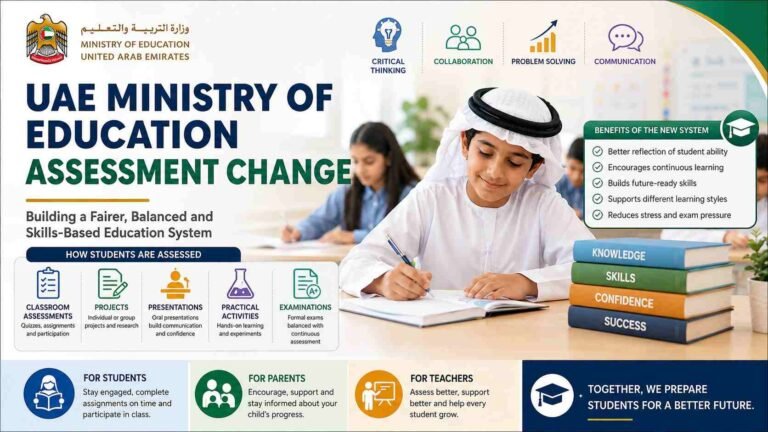
The UAE Ministry of Education assessment changes introduce a more balanced and student-focused way of measuring academic progress. Instead of relying mainly on final examinations, the updated assessment framework evaluates students throughout the academic year using classroom activities, assignments, projects, quizzes, practical work, and examinations.
These changes are designed to improve learning outcomes, encourage critical thinking, identify learning gaps early, and provide students with multiple opportunities to demonstrate their knowledge and skills. The updated system also gives parents and teachers a clearer picture of student progress, making it easier to provide support whenever needed.
Whether you’re a parent, student, or teacher, understanding these assessment changes can help you prepare for the academic year and make the most of the new learning approach.
Quick Facts About UAE Ministry of Education Assessment Changes
| Feature | Details |
|---|---|
| Authority | UAE Ministry of Education (MoE) |
| Academic Year | 2025–2026 |
| Applies To | Public schools and private schools following the MoE curriculum |
| Assessment System | Continuous and comprehensive assessment |
| Assessment Types | Diagnostic, Formative, Summative, Projects and Practical Assessments |
| Main Goal | Improve student learning and reduce dependence on one final exam |
| Benefits | Better feedback, early intervention, continuous learning, fairer evaluation |
| Student Focus | Knowledge, skills, critical thinking, and practical application |
Quick Tip: Parents should regularly check school announcements and communicate with teachers throughout the academic year to stay informed about assessment schedules, student progress, and any updates to the assessment process.
What Are the UAE Ministry of Education Assessment Changes?
The Ministry of Education has updated its assessment policy to better reflect how students learn throughout the year. Rather than measuring achievement based mainly on one or two major examinations, students are now evaluated through different assessment methods that monitor their understanding over time.
The revised framework encourages continuous learning by combining classroom participation, assignments, projects, quizzes, practical activities, and formal examinations. This allows teachers to assess academic progress more accurately while helping students improve their skills consistently.
The updated assessment system also promotes fairness by giving students multiple opportunities to demonstrate what they have learned instead of relying solely on a single exam.
Why Did the Ministry Introduce These Changes?
Education continues to evolve, and today’s students need more than strong exam results. They also need problem-solving abilities, communication skills, creativity, collaboration, and critical thinking to succeed in higher education and future careers.
The Ministry introduced these changes to achieve several important goals.
Improve Student Learning
Continuous assessment helps students stay engaged throughout the academic year instead of studying only before examinations.
Identify Learning Gaps Early
Teachers can quickly identify students who need additional support before small learning challenges become larger academic problems.
Reduce Examination Pressure
Since students are assessed in different ways throughout the year, the overall pressure of final examinations is reduced.
Encourage Practical Learning
Projects, classroom activities, and practical assessments allow students to apply knowledge instead of simply memorizing information.
Provide Better Feedback
Parents receive more regular updates about their child’s progress, helping them support learning at home.
Types of Assessments Under the New System
The updated assessment framework uses several different assessment methods. Each one serves a specific purpose in measuring student learning.
Diagnostic Assessment
Diagnostic assessments are usually conducted at the beginning of the academic year or before starting new learning units.
Their purpose is to:
- Identify students’ current knowledge
- Find learning gaps
- Help teachers plan lessons
- Provide targeted academic support
- Monitor student readiness
Diagnostic assessments are not designed to pressure students. Instead, they help teachers understand where additional instruction may be needed.
Formative Assessment
Formative assessment takes place continuously during classroom learning.
Teachers may evaluate students through:
- Classroom participation
- Homework
- Short quizzes
- Group discussions
- Class activities
- Presentations
- Research assignments
- Individual projects
These assessments provide regular feedback that helps students improve before major examinations.
Summative Assessment
Summative assessments measure what students have learned after completing a topic, unit, or academic term.
Examples include:
- End-of-unit tests
- Mid-term examinations
- Final examinations
- Major subject assessments
These assessments continue to play an important role in determining overall student performance.
Practical and Project-Based Assessment
Many subjects now include practical activities and projects that allow students to apply classroom knowledge to real-life situations.
Students may complete:
- Science experiments
- Research projects
- Presentations
- Collaborative assignments
- Creative projects
- Problem-solving activities
These assessments encourage independent learning while developing valuable practical skills.
How the New Assessment System Works
The updated assessment framework evaluates students throughout the academic year rather than depending mainly on one final examination. Teachers monitor academic progress using different assessment methods, giving students multiple opportunities to demonstrate their understanding.
Depending on the subject and grade level, students may be assessed through:
- Classroom participation
- Homework and assignments
- Short quizzes
- Projects
- Presentations
- Practical activities
- Mid-term assessments
- End-of-term examinations
This balanced approach helps measure both academic knowledge and practical skills.
Continuous Assessment Explained
One of the biggest UAE Ministry of Education assessment changes is the increased emphasis on continuous assessment.
Continuous assessment means that learning is evaluated regularly throughout the school year instead of focusing only on final exams.
Teachers assess students based on their daily performance, assignments, participation, projects, and quizzes. This provides a more complete picture of student achievement while encouraging consistent study habits.
Benefits of Continuous Assessment
Continuous assessment offers several advantages for students, teachers, and parents.
For students, it:
- Reduces exam-related stress
- Encourages regular studying
- Rewards consistent effort
- Builds confidence
- Improves long-term learning
For teachers, it:
- Identifies struggling students earlier
- Helps adjust teaching methods
- Provides ongoing feedback
- Measures student progress more accurately
For parents, it:
- Provides regular progress updates
- Makes it easier to support learning at home
- Highlights strengths and improvement areas before final examinations
How Students Are Graded
Although grading methods may vary depending on the subject and grade level, student performance is generally evaluated using a combination of different assessment activities throughout the academic year.
These may include:
- Classroom work
- Assignments
- Projects
- Practical assessments
- Quizzes
- Mid-term assessments
- Final examinations
Instead of depending on a single examination, final results reflect a student’s overall performance across multiple learning activities.
How the Changes Benefit Students
The revised assessment system aims to create a healthier and more effective learning environment.
Some of the biggest benefits include:
Better Understanding Instead of Memorization
Students are encouraged to understand concepts and apply knowledge rather than memorize answers.
More Opportunities to Succeed
Because assessments take place throughout the year, one poor exam result is less likely to define a student’s overall performance.
Improved Problem-Solving Skills
Many classroom activities now focus on applying knowledge to practical situations instead of recalling facts.
Increased Classroom Participation
Students are encouraged to participate actively during lessons since classroom engagement contributes to continuous assessment.
Stronger Academic Growth
Regular feedback allows students to improve steadily throughout the school year.
What Parents Should Know
Parents play an important role in helping children adapt to the new assessment system.
Here are some ways parents can support student success:
Encourage Daily Learning
Help children develop a regular study routine instead of studying only before exams.
Monitor School Communication
Check school portals, notices, and teacher updates regularly for assessment schedules and assignments.
Focus on Learning, Not Just Grades
Encourage your child to understand concepts rather than simply aiming for high marks.
Stay Connected With Teachers
Attend parent-teacher meetings and discuss your child’s academic progress regularly.
Create a Positive Study Environment
Provide a quiet and organized space where your child can complete homework and prepare for assessments.
What Students Should Do
Students can perform well under the updated assessment system by developing consistent study habits.
Helpful strategies include:
- Attend classes regularly.
- Complete assignments on time.
- Participate actively in classroom discussions.
- Review lessons every week.
- Ask questions whenever concepts are unclear.
- Manage time effectively for projects and assessments.
- Practice problem-solving instead of memorizing answers.
- Stay organized using a study planner.
Following these habits can improve both academic performance and confidence throughout the school year.
Common Misconceptions About the New Assessment System
As the updated assessment framework is implemented, several misconceptions have emerged. Understanding the facts can help students and parents adapt more confidently.
“Final Exams Have Been Removed”
No. Final examinations are still an important part of the assessment system. However, they are now combined with continuous assessment activities to provide a more balanced evaluation of student performance.
“Projects Are Easier Than Exams”
Projects require students to research, analyze information, solve problems, and present their work. They assess different skills than written exams and require careful planning and effort.
“Only Grades Matter”
The new system focuses on overall learning. Teachers also consider participation, assignments, collaboration, practical skills, and consistent academic progress.
“Continuous Assessment Means More Homework”
Continuous assessment is not simply about giving more homework. It includes various classroom activities, discussions, presentations, quizzes, and projects that help teachers monitor learning throughout the year.
How Teachers Benefit From the New Assessment System
The updated assessment framework also supports teachers by providing better insights into student learning.
Some of the key benefits include:
- Identifying learning difficulties at an early stage
- Providing personalized support for students
- Tracking progress throughout the academic year
- Improving lesson planning based on assessment results
- Offering regular feedback to students and parents
- Encouraging interactive and engaging classroom teaching
This helps create a more effective learning environment for everyone.
How Schools Implement the Assessment Changes
Schools following the UAE Ministry of Education curriculum are responsible for implementing the assessment framework according to Ministry guidelines.
Schools generally:
- Plan assessments throughout the academic year.
- Schedule classroom assessments alongside formal examinations.
- Record student progress regularly.
- Share academic reports with parents.
- Provide support for students who need additional assistance.
- Maintain fair and transparent assessment procedures.
While the Ministry provides the overall framework, schools organize assessment schedules according to their academic calendar.
Tips to Help Students Succeed
Students can adjust successfully to the updated assessment system by following a few simple strategies.
Stay Consistent
Instead of studying only before exams, review lessons every week to strengthen understanding.
Complete Assignments on Time
Assignments contribute to continuous assessment and help reinforce classroom learning.
Improve Time Management
Use a planner or calendar to keep track of projects, homework, quizzes, and examination dates.
Ask for Help Early
If a topic is difficult, speak with your teacher before small problems become bigger challenges.
Participate in Class
Class discussions, presentations, and activities often form part of continuous assessment.
Focus on Understanding
Learning concepts thoroughly is more effective than memorizing answers for examinations.
Challenges Students May Face
Like any educational change, adapting to a new assessment system can take time.
Some common challenges include:
- Adjusting to continuous assessments
- Managing multiple assignments and projects
- Balancing extracurricular activities with academics
- Developing better study habits
- Meeting project deadlines
These challenges usually become easier with proper planning, regular study, and support from teachers and parents.
Safety Note
The information in this article is provided for general informational purposes and is based on the latest publicly available UAE Ministry of Education assessment policies. Assessment methods, grading procedures, academic calendars, and school implementation may change over time. Parents and students should always confirm the latest assessment guidelines with their school or the UAE Ministry of Education before making academic decisions.
Frequently Asked Questions
What are the UAE Ministry of Education assessment changes?
The assessment changes introduce a more balanced evaluation system that combines continuous assessment, classroom activities, projects, practical work, quizzes, and examinations to measure student learning throughout the academic year.
Who do the assessment changes apply to?
They apply to UAE public schools and private schools that follow the Ministry of Education curriculum.
Are final exams still part of the system?
Yes. Final examinations remain an important part of student evaluation, but they are now supported by continuous assessment throughout the year.
What is continuous assessment?
Continuous assessment is the ongoing evaluation of student performance through assignments, classroom participation, projects, quizzes, presentations, and other learning activities.
Why were these changes introduced?
The Ministry introduced these changes to improve learning outcomes, encourage critical thinking, identify learning gaps earlier, reduce exam pressure, and provide more meaningful feedback to students and parents.
How can parents support their children?
Parents can encourage regular study habits, monitor school communications, attend parent-teacher meetings, and create a positive learning environment at home.
How can students perform well under the new system?
Students should attend classes regularly, complete assignments on time, participate actively in lessons, review subjects consistently, and focus on understanding concepts rather than memorizing information.
Will every school use the same assessment methods?
Schools following the Ministry curriculum implement the Ministry’s assessment framework, but some assessment schedules and classroom activities may vary depending on the grade level and school calendar.
Conclusion
The UAE Ministry of Education assessment changes represent an important step toward creating a more balanced, fair, and student-centered education system. By combining continuous assessment with formal examinations, students have more opportunities to demonstrate their knowledge, develop practical skills, and improve throughout the academic year.
For parents, the updated framework provides clearer insight into their child’s progress, while teachers can offer timely support based on regular assessments. Students who stay organized, participate actively in class, and maintain consistent study habits are well positioned to succeed under the new system.
For more verified UAE education guides, school updates, and practical resources for students and parents, keep visiting EmaratSmart.com.