
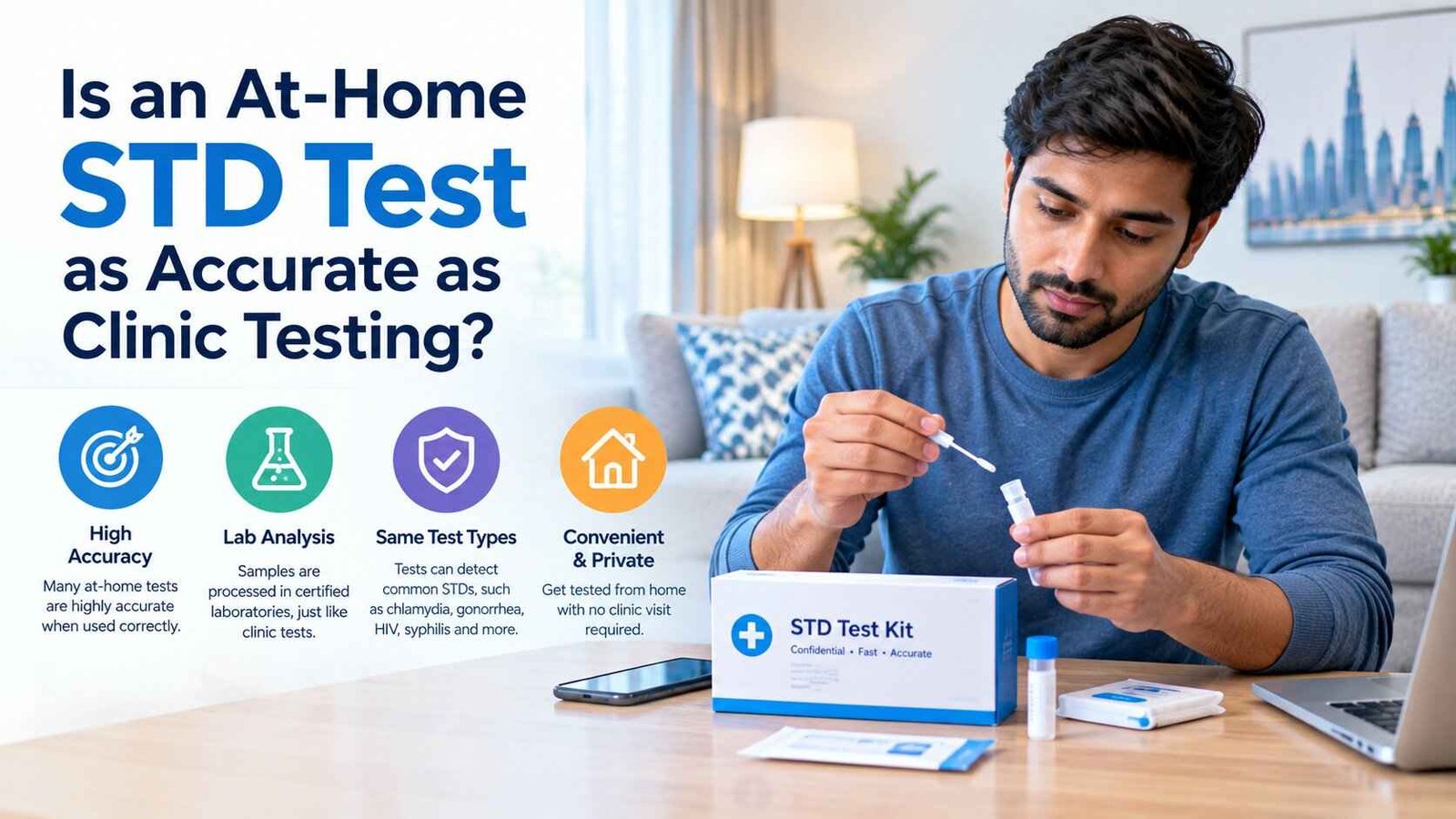
Is an At-Home STD Test as Accurate as Clinic Testing?
When people consider sexual health screening, one of the most common questions is whether testing at home can provide results comparable to testing at a clinic. The answer depends less on the location where the sample is collected and more on the type of test, sample quality, laboratory methods, and timing of the test.
An At home std test can involve medically supervised sample collection followed by laboratory analysis, depending on the healthcare provider and testing service.
This means that a home-based test is not necessarily a less reliable alternative simply because the sample is collected outside a clinic.
However, understanding how the process works can help you make an informed decision about sexual health screening.
How Accurate Is Testing Outside a Clinic?
The accuracy of an STD test depends on several factors. These include the infection being tested for, the diagnostic method used, the type of specimen collected, and how long after potential exposure the test is performed.
A clinic and a home-based service may use the same or comparable laboratory testing methods. If a properly collected specimen is processed by an appropriate laboratory, the physical location where the sample was obtained does not automatically determine the accuracy of the final result.
However, not every home testing option works in the same way. Some services involve a healthcare professional collecting the sample, while others may involve self-collection. The instructions provided with a test should therefore be followed carefully.
Timing is another important consideration. If testing occurs too soon after exposure, an infection may not yet be detectable. This is known as the window period, and it varies between infections and testing methods.
What Factors Can Affect a Test Result?
Sample quality is particularly important. Blood, urine, and swab samples each have specific collection requirements. An incorrectly collected, contaminated, insufficient, or improperly stored specimen can affect the usefulness of the test.
The laboratory also matters. Reliable testing depends on appropriate diagnostic procedures, quality controls, sample handling, and accurate reporting.
Your medical history can also influence which test is appropriate. The type of sexual contact, symptoms, previous infections, recent treatment, and timing of a potential exposure can all be relevant when deciding what should be tested.
For this reason, choosing a test solely because it is convenient may not provide the complete picture. Appropriate test selection is an important part of accurate screening.
At-Home Testing Compared With Clinic Testing
The main difference between home and clinic testing is often the setting in which the initial assessment and sample collection take place. The actual laboratory analysis may follow similar procedures when the same type of diagnostic test is used.
For example, someone may visit a clinic where a healthcare professional collects a blood or swab specimen. With a home-based service, a qualified professional may visit the person’s location and collect the required specimen there.
In both situations, the sample can be transported to a laboratory for analysis. Therefore, it is useful to look at the entire testing pathway rather than assuming that clinic testing is automatically more accurate.
An std test at home may be appropriate for people who want greater privacy or convenience, particularly when travelling to a clinic is difficult.
| Factor | At-Home Testing | Clinic Testing |
| Sample location | Patient’s home or chosen location | Medical facility |
| Sample collection | Self-collected or professionally collected, depending on service | Usually collected by healthcare staff |
| Laboratory analysis | May be performed by a diagnostic laboratory | May be performed by a diagnostic laboratory |
| Privacy | Home environment may offer greater privacy | Private clinical setting |
| Medical consultation | Depends on the service | Generally available at the clinic |
| Test selection | Depends on provider assessment | Can be selected during clinical consultation |
| Convenience | No clinic travel may be required | Requires visiting the facility |
| Follow-up | Depends on provider | Often available through the clinic |
The table shows why comparing accuracy based only on location can be misleading. The important questions are what is being tested, how the specimen is collected, where it is analysed, and whether appropriate medical guidance is available.
What Types of Samples Are Used?
Different sexually transmitted infections require different testing approaches. A healthcare professional may recommend blood, urine, or swab testing depending on the infection being investigated and the patient’s circumstances.
Blood-based testing can be used for certain infections, while urine or swab specimens may be more suitable for others. Some situations may require more than one type of specimen.
A std test at home dubai service may therefore involve different collection methods depending on the screening panel selected. There is no universal sample that can detect every sexually transmitted infection.
Symptoms also do not always indicate which infection is present. Some STIs can produce similar symptoms, while others may cause no noticeable symptoms at all. This is why targeted testing can be more useful than relying on symptoms alone.
Why Timing Matters for Accuracy
Testing immediately after a possible exposure may not provide a definitive answer for every infection. Different diagnostic tests become capable of detecting an infection at different points in time.
For this reason, a healthcare professional may recommend testing at a particular interval after exposure or suggest repeat testing when appropriate.
A negative result should therefore be interpreted according to the test used and the time between possible exposure and sample collection. If testing was performed very early, follow-up may sometimes be necessary.
What Makes an At-Home Test Reliable?
A reliable home testing service should have a clear process for identifying the patient, collecting the correct specimen, handling it safely, transporting it appropriately, and providing the result through a secure system.
Medical supervision can also be valuable. If you are uncertain which test you need, speaking with a healthcare professional can help prevent unnecessary or inappropriate testing.
An at home std check should not be considered reliable simply because a test kit is available. The quality of the complete process matters.
If a healthcare professional collects the sample, they can also help ensure that the appropriate collection procedure is followed. This may be particularly useful for tests where specimen quality has a significant effect on the result.
People who require several types of medical investigations may also consider a broader lab test at home service when appropriate. However, the tests should still be selected according to individual medical needs rather than convenience alone.
What Happens After You Receive the Result?
A laboratory report is only one part of the diagnostic process. If the result is negative, it should be considered alongside the timing of the test, the infection being investigated, and any ongoing symptoms.
If the result is positive, further medical guidance may be needed. Depending on the infection, this could involve confirmatory testing, treatment, partner notification, or follow-up screening.
It is important not to self-diagnose or begin treatment based solely on an online interpretation of a result. A healthcare professional can explain what the result means in your particular circumstances.
A std test home service can provide convenient access to screening, but the result should still be interpreted within the appropriate clinical context.
When Should You Choose Home or Clinic Testing?
The choice between home and clinic testing depends on your needs and the nature of the health concern.
Home testing may be convenient when privacy, travel time, or scheduling is a concern. Clinic testing may be more suitable when you have significant symptoms that require a physical examination or when you need immediate access to broader medical services.
If you have symptoms such as unusual genital discharge, sores, painful urination, genital irritation, pelvic pain, or unexplained changes after a potential exposure, medical advice can help determine the appropriate next step.
People without symptoms may also seek screening after a potential exposure, depending on their circumstances and healthcare provider’s advice.
Ultimately, accuracy is not determined simply by whether a specimen was collected at home or inside a clinic. The test itself, appropriate sample collection, laboratory processing, timing, and medical interpretation all contribute to the usefulness of the result.
For anyone considering STD testing, the most important step is choosing an appropriate test for the infection being investigated and following the recommended testing timeframe. When these factors are addressed properly, home-based screening can be a practical option for people who prefer private and convenient healthcare.