UAE Ministry of Education Assessment Change
The UAE Ministry of Education assessment change has introduced updates to how students are evaluated across schools in the UAE. These changes aim to create a fairer, more balanced, and skills-based education system that measures understanding rather than memorization.
If you’re a student, parent, or teacher, you may be wondering what has changed, why these updates matter, and how they affect academic performance. This guide explains everything in simple language so you can understand the new assessment system and prepare with confidence.
What Is the UAE Ministry of Education Assessment Change?
The UAE Ministry of Education has updated its assessment framework to better reflect students’ knowledge, practical skills, critical thinking, and overall learning progress.
Instead of relying heavily on traditional exams, the revised approach combines different types of assessments throughout the academic year. This gives students multiple opportunities to demonstrate what they have learned while reducing the pressure of a single final exam.
The goal is to support continuous learning, encourage creativity, and provide a more accurate picture of student achievement.
Why Did the Ministry Introduce These Changes?
Education systems around the world continue to evolve as workplaces demand more than memorization. Students need problem-solving, communication, collaboration, and digital skills.
The assessment changes were introduced to:
Create Fairer Student Evaluation
Students are evaluated through multiple assessment methods instead of depending on one major examination.
Encourage Critical Thinking
Questions increasingly focus on understanding concepts, applying knowledge, and solving real-life problems.
Reduce Exam Pressure
Continuous assessment spreads evaluation throughout the school year, helping reduce stress during final examinations.
Improve Learning Outcomes
Teachers receive better information about student progress, allowing them to provide additional support where needed.
How the New Assessment System Works
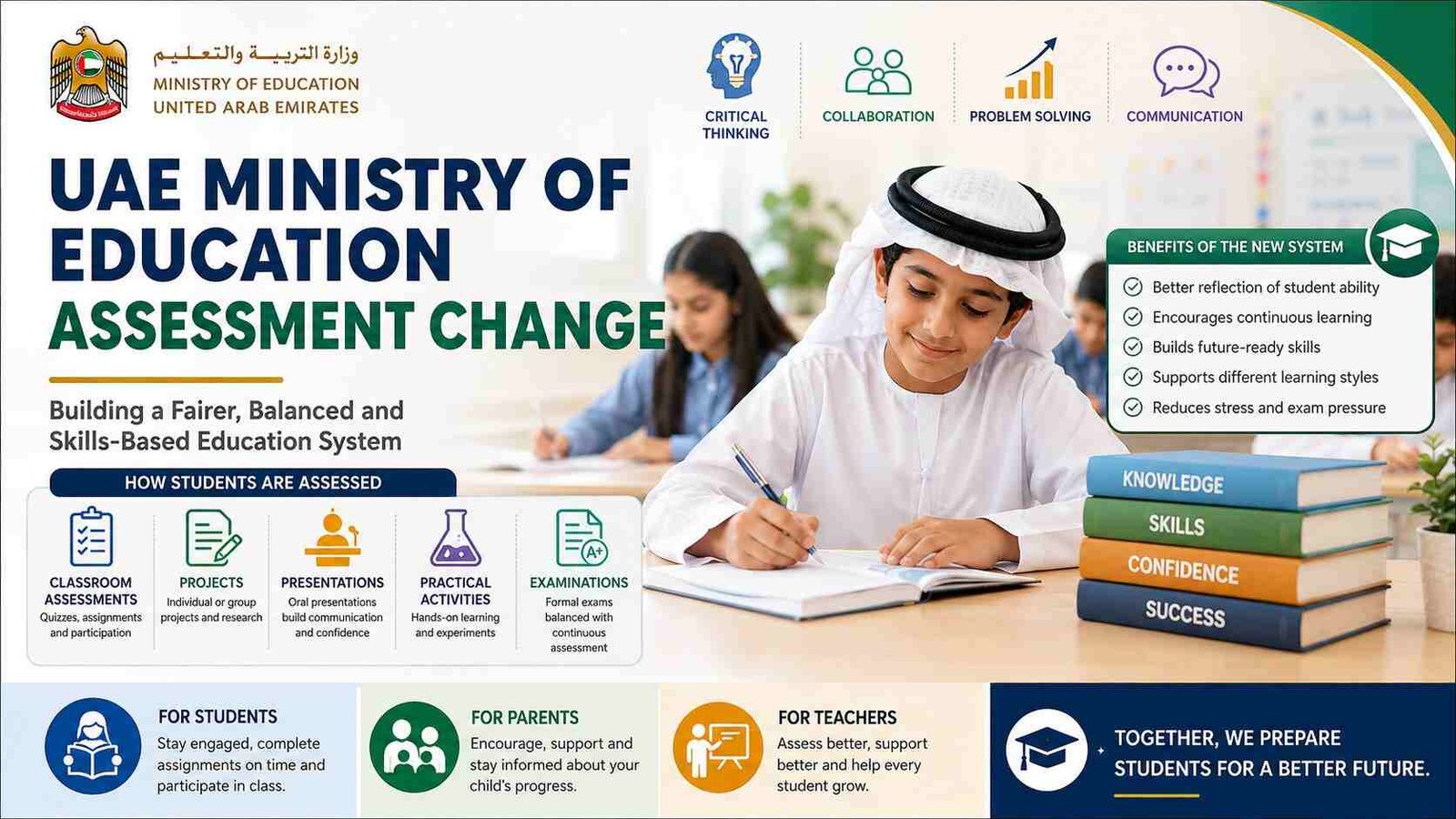
Although implementation may vary depending on the school and grade level, students may now be assessed through a combination of:
Classroom Assessments
Teachers regularly evaluate student participation, assignments, quizzes, and classroom activities.
Projects
Students complete individual or group projects that test practical understanding and research skills.
Presentations
Oral presentations help develop communication and confidence while allowing teachers to assess subject knowledge.
Practical Activities
Subjects like science, technology, and vocational studies may include hands-on assessments.
Examinations
Formal exams remain an important part of evaluation but are balanced with continuous assessment throughout the year.
How Students Are Affected
The UAE Ministry of Education assessment change encourages students to stay engaged throughout the academic year rather than studying only before exams.
Students should focus on:
- Completing assignments on time
- Participating in class
- Preparing for quizzes regularly
- Developing research skills
- Improving critical thinking
- Managing time effectively
Consistent effort is now more valuable than last-minute exam preparation.
How Parents Can Support Their Children
Parents play an important role in helping students adjust to the new assessment system.
Some practical ways to help include:
Create a Study Routine
Encourage daily revision instead of waiting until examination periods.
Monitor Assignments
Check school portals and homework regularly to ensure tasks are completed on time.
Encourage Reading
Reading improves vocabulary, comprehension, and critical thinking across all subjects.
Reduce Unnecessary Pressure
Support learning rather than focusing only on grades.
Communicate With Teachers
Stay informed about assessment schedules and student progress.
How Teachers Benefit
Teachers receive more opportunities to evaluate student learning throughout the academic year.
Benefits include:
- Better understanding of student strengths
- Early identification of learning gaps
- More personalized teaching strategies
- Improved classroom engagement
- Better feedback for students and parents
Advantages of the New Assessment System
Better Reflection of Student Ability
Students are assessed through multiple methods instead of a single examination.
Encourages Continuous Learning
Learning becomes a year-round process rather than exam-focused.
Builds Future Skills
Students develop communication, collaboration, creativity, and analytical thinking.
Supports Different Learning Styles
Not every student performs best in written exams. Multiple assessment methods allow students to demonstrate their abilities in different ways.
Reduces Stress
Balanced assessments help reduce the pressure associated with high-stakes examinations.
Challenges Students May Face
Like any educational change, there can be challenges during the transition.
Some students may initially struggle with:
- Time management
- Increased project work
- Regular assessments
- Adapting to different evaluation methods
Fortunately, these challenges usually become easier with proper planning and consistent study habits.
Tips to Perform Well Under the New Assessment System
Stay Organized
Use a planner or digital calendar to track assignments and assessment dates.
Review Lessons Regularly
Spend 20–30 minutes revising each subject every day.
Ask Questions
If you don’t understand a topic, ask your teacher before assessments.
Practice Problem Solving
Focus on understanding concepts instead of memorizing answers.
Participate in Class
Class participation often contributes to continuous assessment.
Manage Your Time
Break large projects into smaller tasks to avoid last-minute stress.
Common Misconceptions
“Final exams no longer matter.”
This is incorrect. Exams remain important but are balanced with continuous assessment.
“Projects are easier than exams.”
Projects require research, planning, teamwork, and presentation skills.
“Only grades have changed.”
The new system also emphasizes learning skills, critical thinking, and practical application.
Why These Changes Matter for the Future
Modern careers require adaptability, creativity, teamwork, and analytical thinking.
The updated assessment system helps students build these skills while improving academic knowledge. It prepares learners for higher education and future workplaces where practical abilities are just as important as exam results.
Frequently Asked Questions
What is the UAE Ministry of Education assessment change?
It refers to updates in how students are evaluated, using a combination of continuous assessments, projects, classroom activities, and examinations.
Does this change remove final exams?
No. Final exams are still used, but they are balanced with other assessment methods.
Who is affected by the assessment change?
Students, teachers, parents, and schools following the UAE Ministry of Education curriculum.
Why were these changes introduced?
The goal is to improve learning outcomes, reduce exam pressure, and develop practical skills alongside academic knowledge.
How can students prepare?
Students should study consistently, complete assignments on time, participate actively in class, and practice applying concepts instead of memorizing information.
Do projects count toward final grades?
In many cases, projects and continuous assessments contribute to overall student performance, depending on the school’s assessment framework.
Conclusion
The UAE Ministry of Education assessment change represents an important step toward a more balanced and modern education system. By combining examinations with continuous assessments, projects, classroom participation, and practical learning, students have more opportunities to demonstrate their abilities throughout the year.
Students who stay organized, study consistently, and actively participate in learning activities are likely to adapt successfully to the new system. Parents and teachers also play a vital role by providing encouragement, guidance, and regular support. As education continues to evolve, these assessment changes aim to prepare students not only for academic success but also for the skills needed in higher education and future careers.